Thursday, August 30, 2007

A lot of laughter shared over a lemon meringue pie


By Jnet

For several years now, I've gone back and forth in my consideration for taking on a life of religious vocation.

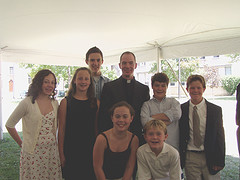
G took me to visit with his sister in the Bay Area who is a numerary of Opus Dei and I was charmed by the sisterhood life that L is living. She is an optometrist and she lives with a diverse group of women that are the best of friends. There was a lot of laughter shared over a lemon meringue pie. Opus dei's philosophy of life is that the daily life is a "work of God".... therefore, being a great teacher, optometrist, college student, or homemaker can be lived to the gratitude and celebration of God.

L lives in a beautiful community and all the women; young and older are absolutely lovely people... inside and out. I asked my questions regarding the image that the book "The Da Vinci Code" creates about their organization and found it absolutely funny that a work of fiction has managed to create such distortion.

Is Opus Dei for me?

Opus Dei certainly has a certain appeal that contrasts with the ascetic life of a nun. Knowing myself, I know I am not a perfect fit for a cloistered Christian life. Not that I think that having a faith and being committed to its corresponding community is wrong or insular. It is due to their special commitment that the health of their spiritual community grows and thrives. They are a system of people that are essential but no better than other systems. Does a body think the nervous system better than the immune system?

L and her friends have found and created their home.

My place in this spiritual world is still under construction. I don't have a "name" for that home or a certain community that I belong to exclusively...

But I certainly consider life as an opportunity to celebrate and live as an "opus dei" a work of God. My champagne days continue toasting to the beauty and diversity of life.

JNET

Tuesday, August 28, 2007

She needs a pair of lungs NOW!

Three favors granted by St. Josemaria

I conquered the temptation with the help of St Josemaría
I am an Acolyte in our little but strong parish. Our Sacristan Major decided to give us formal training and teaching all about being an Acolyte. So, he called a nun who was the one who gave us the seminar. After the seminar, before leaving us, the nun gave us a Prayer Card of St Josemaria. I kept it, thinking that it was nothing important... After several days, there was a great temptation that blocked my way from doing some noble acts. I remembered the Prayer Card, I got it and I prayed. What happened was I conquered the temptation with the help of St. Josemaria.
Glenn, Philippines
July 19, 2007

A lung transplant
I have lived in Stockholm for two years and I work as a physiotherapist with patients who suffer from cystic fibrosis, a disease that affects the lungs. One of my patients had been waiting over a year for a lung transplant. A fortnight ago this patient was hospitalized in a very bad state. On Sunday, when I went to give her treatment, I could see that she was so seriously ill – almost dying – that I felt desperate, and as I left the hospital I said, “St Josemaría, I can’t remember your prayer, but this girl needs a pair of lungs NOW!” On Monday I got a surprise: I’d hardly set foot in the hospital when I heard that my patient had been transferred to Lund in the south of Sweden very early that day, because “by chance” new lungs had been found for her! Everything is now going well.
M. C. R., Sweden
July 5, 2007

Music that brings people closer to God
I am 19 and an organist. On June 24, two days before St Josemaría’s feast-day, I gave a concert of sacred music. During the concert I had the prayer-card of St Josemaría next to my sheets of music. I prayed to him to help me offer those present music that would help them draw closer to God. The concert was a great success. Thank you, St Josemaría.
Jean-François, France
July 4, 2007

Taken from: http://www.josemariaescriva.info/index.php?id_cat=401&id_scat=284

Sunday, August 19, 2007

I feel good in this family

By Aurelio from Milan, Italy

Quote: Originally Posted by westcoast
Has anyone here "joined" Opus Dei? How is it? How did you know you should have joined? I'm just looking up stuff on it and find it interesting....


I am a supernumerary faithful of the Prelacy (I hope the English expression is accurate, I am Italian) for more than 20 years.

How is it? Your question is a bit vague, I can say that I know this is my way, chosen by God, to go to Him.

I like this "place", I realized in all these years it's a real family. I feel good in this family, because it's mine, I mean... anywhere God puts us, in time we find it's great, don't we?

I have personally experienced that this is a "spot" where freedom - in what is not Church's doctrine - is deep, and for my rather unconformist character this is priceless.

How did I know I should have joined? I frequented Opus Dei's formation means in my university years, after a few years I was deeply convinced it could be my way and... "they" didn't say me no.

All the best

Aurelio

From: http://forums.catholic.com/showthread.php?p=2578305#post2578305

Friday, August 10, 2007

St. Josemaria Escriva and His Contribution to the Church

By Bishop Robert W. Finn of Kansas City-St. Joseph

About a month ago, I celebrated a Mass at one of our parish churches marking the feast of a modern day saint, Josemaria Escriva, who is perhaps best known as the founder of a Catholic group called Opus Dei. I thought I would take this space today to talk about this Spanish diocesan priest who was canonized by Pope John Paul II on Oct. 6, 2002, and whose feast day is observed in the Church throughout the world on June 26.

Josemaria Escriva de Balaguer was born in Barbastro, Spain, on Jan. 9, 1902, and died in Rome on June 26, 1975. As a child he was sickly, and at one point he was near death. His health rallied when his parents took him to a Marian shrine in Spain. As a child he witnessed the deaths of his three sisters, the collapse of the family business and his father's early death, all of which seemed to only strengthen his reliance on God.

As a teen, Josemaria noticed one day the footprints left by a Carmelite priest walking barefoot in the snow, and felt God was calling him to a greater generosity. He was ordained a priest in March 1925 and often asked God, in prayer, to help him "see" His plan for him.

On Oct. 2, 1928, the feast of the Guardian Angels, he "saw" by a kind of divine inspiration a plan for holiness and evangelization in the world, a way of living that would help people be holy in the very concrete and everyday responsibilities of their life. Initially, he understood this as an association for lay men; later he realized it was also something that was to be extended to lay women.

He eventually also established the Priestly Society of the Holy Cross for diocesan priests, when he saw what poor spiritual formation they often had. While the priests remain completely attached to their local bishop and diocese, the Society provides them with support and sound spiritual direction.

Lay men and women constitute 95% (or more) of the membership of Opus Dei. Some of these are unmarried men or women who live in centers of "the Work." There are separate centers for men and women. They have daily jobs as engineers, business men or women, lawyers, doctors, etc., and have meals and prayer in common. They do some kind of apostolate or work that involves promoting a holy life in the midst of the world. They often might teach Catholic catechism and give spiritual direction.

Although he had great respect and love for consecrated men and women, St. Josemaria was insistent that what he "saw" was not a religious order. It was a vocation to find holiness in the world, by doing our daily work with great love.

He wanted to remind Christians that "sanctity is not something for the privileged few." Rather, "all paths of the earth can be divine."

Curiously this sense of the Universal Call to Holiness for every person is often associated with the teachings of the Second Vatican Council.

Father Josemaria promoted it in a concrete way nearly 40 years before the Council! Father Josemaria and his first associates had to live their faith somewhat "underground" during the Spanish Civil War (1936-1939), when many priests and Religious were killed for their faith.

Father Josemaria was a charismatic and fatherly personality who had great humility and a strong compassion for the sick. During the Council he was highly regarded and many bishops from all over the world visited him in Rome to ask his advice about the early documents and discussions of the Council, particularly about the role of the laity in the Church.

By the time of his death, Father Josemaria's Work had spread to 80 countries. The most recent center was established in Russia in the last months. To learn more about St. Josemaria Escriva, go to www.stjosemaria.org.

O God, through the mediation of Mary our Mother, you granted your priest Saint Josemaria countless graces, choosing him as a most faithful instrument to found Opus Dei, a way of sanctification in daily work and in the fulfillment of the Christian's ordinary duties. Grant that I, too, may learn to turn all the circumstances and events of my life into occasions of loving you and serving the Church, the Pope and all souls with joy and simplicity, lighting up the pathways of this earth with faith and love. Deign to grant me through the intercession of Saint Josemaria, the favor of . (make request).. Amen.

Taken from: Fergal O'Neill at In Manus Tuas

Archbishop Romero: Friend of Opus Dei

By Ratzinger Fan Club

via Wheat and Reeds, the suprising (and delightful) news that Archbishop Romero was a son of Opus Dei. This from a letter Archbishop Romero wrote to Paul VI, after St. Escriva's death:

"I had the good fortune of knowing Monsignor Escriva de Balaguer personally and of receiving from him support and fortitude to be faithful to the inalterable doctrine of Christ and to serve with apostolic zeal the Holy Roman Church and this land of Santiago de Maria, which Your Holiness has entrusted to me.

"I have known, for several years now, the work of Opus Dei here in El Salvador, and I can testify to the supernatural sense that animates it and to the fidelity to the ecclesiastical magisterium that characterizes the work.

"Personally, I owe deep gratitude to the priests involved with the work, to whom I have trusted with much satisfaction the spiritual direction of my life and that of other priests.

"People from all social classes find in Opus Dei a secure orientation for living as sons of God in the midst of their daily family and social obligations. And this is doubtless due to the life and doctrine of its founder.

"In this stormy world overrun by insecurity and doubt, the superb doctrinal fidelity that characterizes Opus Dei is a sign of special grace from God.Source: Romero & Escriva - Fr Ray Blake @ St Mary Magdalen (Brighton).

James R. Brockman, S.J., in "The Spiritual Journey of Oscar Romero", writes:

Romero remained an auxiliary bishop of San Salvador until October of 1974, when he was named bishop of Santiago de Maria, a rural diocese. He remained in Santiago until named archbishop of San Salvador in February of 1977, at the age of fifty-nine. During these five years, his retreat notes show him continuing to work on the problems of getting along with others and trying to organize his life better, as he had in earlier retreats. At least two of the retreats he made were preached by priests of the secular institute Opus Dei, and during these years and perhaps earlier his ordinary confessor and spiritual director was one or another priest of Opus Dei. While he was bishop of Santiago de Maria, he wrote to Pope Paul VI to appeal for the beatification of [Escriva].

Saturday, July 28, 2007

Review: Ordinary Work, Extraordinary Grace

By LifeTeen.com
Name: Ordinary Work, Extraordinary Grace
Publisher: DoubleDay
Author: Scott Hahn

Our Call:


Story: Dr. Scott Hahn always makes his theology very personal, and this book is no different. Drawing on his painful journey from being a Protestant pastor to becoming a Catholic theologian, he offers the readers a glimpse at how many of the men and women in Opus Dei helped him on his journey.

Many in the media label Opus Dei as a ‘secret society,’ even portraying them as the evil group behind the plot of the inaccurate Da Vinci Code. The reality is that Opus Dei, meaning the Work of God, has only one agenda: the passionate love of the world. Hahn shows us in this book just how Saint Josemaria Escriva embodied this agenda of loving the world without becoming worldly. A Christian is to live this passionate love through, shockingly plain enough, one’s ordinary work.

Hahn spends an entire chapter explaining the concept of becoming God’s son or daughter, and weaves this theme throughout the book. All of the other practices of Opus Dei must be seen through this lens. Focusing upon the spirituality of Opus Dei rather than defending its mission from the media turns out to be the best choice, as Hahn does an excellent job of showing God’s Work in every detail of ordinary life: one’s job, school, marriage, children, and social activities.


From this vantage point, Hahn then goes into depth on the theology of work that is both sublime and practical, spending several chapters on this endeavor. He also treats topics of the Marian spirituality, of the example of Saint Joseph and how divine grace filled his hidden labors as a carpenter, and how the marriage bed can lead the spouses to holiness. One of my favorite chapters is on the importance of friendship and confidence. Did you know that in the first 300 years of the Church, during intense persecution, the Catholic Church grew by 40% every decade? This was not because Christianity was fun; any public exercise of Christianity often ended through torture and death. It was solely through the friendship of Christians with non-Christians and the holiness of their daily, ordinary, graceful lives.

Objectionable: Nothing.

Pro-Social: Do you ever think that if you want to be holy, you have to work for the Church, like being a youth minister, nun or priest? This book shows us how to be saints in the secular. Holiness is universal.

Summary: This book is for anyone wishing to know more about Opus Dei or St. Josemaria Escriva. Its insights can renew your faith and spirituality and your work ethic in school, at home, and on the job.

The Threat of Opus Dei

By Thomas Reeves at the History News Network of the George Mason University

Dan Brown’s best-selling novel The Da Vinci Code compounds its blatant and at times absurd historical errors with a full-blown attack on the Catholic organization Opus Dei. According to the author, Opus Dei is an evil, wealthy, conniving cult that poses a danger to much of the world. Opus Dei officials have answered the charges in full, exposing them to be malevolent nonsense. (See www.opusdei.com.) Still, you have to give Brown credit for consistency; he is almost always wrong.

Opus Dei is a thoroughly recognized and approved organization within the Catholic Church. Founded in 1928 by Saint Josemaria Escriva, it has some 83,000 lay members in about 60 countries (3,000 in the United States), some 2,000 priests, and tens of thousands of “Cooperators” who assist the organization in a variety of ways. Millions participate in Opus Dei retreats, worship services, and social justice programs. Doctrinally, the organization is wholly orthodox, teaching the faith expressed in the Catechism and nothing else. This is a major reason it has enemies. The Left inside the Church is often just as angry as their brethren outside the body of the faithful, especially when it comes to teaching concerning sexual matters.

My wife and I first became acquainted with Opus Dei people in the Milwaukee area in 1997. They are among the finest human beings we have ever met. That impression has remained consistent over the years as our Opus Dei acquaintances have extend beyond our area. Nothing even suggesting the villainy found in Brown’s book has crossed our path.

Still, nothing on this globe is perfect, and one may expect some criticisms to ring true. Is Opus Dei smug and secretive, as is often claimed? Well, some members do appear smug, but never, in my experience, in an offensive way. They belong to a very select and rigorous organization. One doesn’t just sign up; there is a lengthy period of scrutiny before one may belong (again, see the Opus Dei website), and the daily spiritual exercises are not for the weak and the lazy. I call Opus Dei the Marine Corps of the Church. And the Marines are a pretty proud group. Still, if you criticized an Opus Dei member for smugness, chances are that he or she would be mortified, see a confessor, and make every effort to return to the radical humility mandated by the organization’s founder.

Secretive? Well, the organization does keep a rather low profile; you won’t see Opus Dei signs anywhere, not even outside the living quarters of its celibate members. But that is in keeping with the teachings of Saint Josemaria, who wanted the praise and glory to go upward rather than to those attempting to carry out the Good News. It may well also reflect a history of persecution of Opus Dei, especially by the Communists in Spain, where the organization originated. During the Spanish Revolution, it will be recalled, Reds slaughtered thousands of nuns, priests, and laity, and Saint Josemaria barely escaped with his life.

Read Opus Dei literature for yourself to see the founder’s vision. You might begin with The Way, a pocket-sized volume by Saint Josemaria that provides comfort and inspiration to millions. It contains nothing more nor less than the Catholic faith. Opus Dei operates its own press, making available some of the finest Catholic books and pamphlets ever written. It offers a New Testament with commentary, often by the early Church Fathers, that is most helpful to even veteran Christians.

Opus Dei does a great deal to help the physical and intellectual, as well as spiritual, lives of people all across the world. Members are especially mindful of the poor and needy, as Jesus Christ commanded. One nearby example is the Midtown Educational Foundation in Chicago, founded in 1965. (See www.midtown-metro.org.) In a recent “Report Card,” the MEF described itself thus: “Midtown Educational Foundation (MEF) helps inner-city youngsters to become better students and better people through its sponsorship of the metro Achievement Center for girls and Midtown Center for boys in Chicago and Waukegan, Illinois. Metro and Midtown’s after-school and summertime programs integrate academics with virtues.”

Visit Midtown Center for boys visit Metro Achievement Center

Between 1997 and 2004, 209 young men and women from Chicago’s inner city participated in MEF programs. A study by an independent consulting firm (See www.newtrac.com), showed that 89% of MEF alumni went on to college, as opposed to 20% of Hispanic and African-American students nationwide. An astounding 98% of MEF alumni graduated from high school, as opposed to 44% of their peers in Chicago public schools. Thirty percent of alumni surveyed said they participate in community volunteer activities.

MEF has an annual budget in excess of $2 million, raised in part by a board of directors containing some of the area’s leading business and professional men and women. The Chicago Bears organization has long supported MEF, and the Bears Care Foundation recently donated $25,000. Everyone may volunteer time and money to help youngsters reach their potential. Board member Joe Lane said recently, “What interests me most about MEF is its focus on motivating students. With some help from committed adults in the business community, these kids can prepare themselves for college and get ahead ‘on their own.’ MEF is a wonderful intersection between people who want to help and motivate students. It creates a cycle of success that continues to reach into communities where a little boost can make a big difference.”

The “threat” of Opus Dei, then, is its effort to promote Catholic orthodoxy and carry out the Gospel teachings of love and mercy. It is often said that you are known by the enemies you make. Those especially who hate the Christian faith and the Catholic Church do well to oppose Opus Dei, for it intends to do everything in its power to support, emulate, and encourage both.

Thursday, July 26, 2007

If possible, go to a recollection

By Gwenred of Down Yonder (South!) at Catholic Answers Forum (Anyone part of Opus Dei?)

I am not a member of Opus Dei, but was a "cooperator" for several years. I guess I still am, although where I live now, the closest recollection or retreat I could go to is three hours away, so I have not been active.

I love the spirituality, the writings of St. Josemaria Escriva, and their priests are the best for confession. Ignore the lies that are spread by ODAN, and if possible, go to a recollection. You'll meet members and cooperators (friends) and you'll be able to see for yourself what they are about, namely doing their best to become saints in the midst of the world.

Peace!

Wednesday, July 25, 2007

That'll larn 'ee

My grandpa, upon seeing a toad, run over in the road, said

"that'll larn 'ee to be a toad"
I'm not sure where he picked up this line (meaning that that will teach you to be a toad, because if it's in you nature to be stupid enough to walk out into a road, you will reap the consequences) because he didn't have a regional accent.

"That'll larn 'ee to join Opus Dei". I love being a member of Opus Dei. I love this vocation that helps me to live my faith, and also gives me the support that I need to live it. But sometimes it is tough. Members of Opus Dei try to do a number of 'norms' each day, for example 30 mins prayer in the morning, 30 mins prayer in the afternoon, daily Mass, Holy Rosary, spiritual reading. All of it is very helpful if one is trying to live a Christian life, but it is hard to live, especially without an oratory. Living in Ashwell, it was so easy to roll out of bed, take a shower, dress and pray in the oratory, before Mass. Coming home, there was an oratory. Now, after an hour commute, I arrive home, where I have a lovely house, but there is music playing, or the TV is on. There is no oratory. It is so much harder not to get distracted (and I could get distracted in a padded cell, so my starting position is already disadvantaged).

Every person needs to strive to become closer to God and to live a life that is devoted to Him more and more with every day. For me, at this moment of disorder and distraction and exhaustion (and laziness), I suppose that has a lot to do with making a good plan each day, so that I know exactly when and how I will do the norms, so that I can come to love God more...

From: http://superdolly.blogspot.com/search/label/Opus%20Dei

Tuesday, July 24, 2007

Sixty Years Later

A neighborhood of Warsaw

By a ninety year old who had a chance encounter with her old home

By chance I found myself on Filtrova Street in Warsaw, where I had lived during the war, from September 1939 to November 1944. I was standing in front of my family home. In this house, I, with my mother, my father and my aunt (the owner), had been seized by the Nazis and then sent away to the concentration camps. My aunt died in the Ravensbrück camp and my father in Oranienburg. I returned from Oranienburg with just my mother. In the meantime, our house had been confiscated. Since that time I had never returned to Filtrova Street. I tried to avoid it because it held too many painful memories. . . .

On this 26th of June I entered Filtrova Street from the side of Nautowich Square. I walked and walked. I do not why; I still cannot explain it. And so I came to our house, 27 Filtrova Street. Standing outside I could see that everything was well kept and that the garden and the bright, pretty entrance had been restored. I said to myself, "O my God, the garage is just as it was before." And I asked myself, "How is the garden behind the house?" I put my hand on the latch of the gate, although I should say that I am not one of those people who will enter just anywhere and start looking around. I pressed down the latch and entered the garden to see if it was the same. It was as if I was doing all this without being aware of it. Then I thought, "There may be a dog," and I went back a few steps.

Then I noticed that the steps were placed in a different way and that the doorstep had also been changed. I went up the steps and there was a doorbell. I don't know why, but I pushed the bell. The door opened, and a young man with a pleasant appearance came out. I think he had glasses. I was very struck and he said, "Can I help you"? I answered that I just wanted to see the garden and he invited me to enter it. I said that in this place there had been a terrace. He looked surprised and I told him that this had been my family home where I had lived during the war. He let me enter the house and I found myself in the entrance hall. I hardly recognized anything. I went down a hallway that had led to the old living room, the room where we had been detained in 1944. The living room, however, had disappeared and now there was a chapel. In the chapel a priest was praying and he smiled when he saw me. I said good-by politely and left. I had too many things swirling around in my head.

It turns out that in that house, fifty years later, there was a center of Opus Dei. I knew nothing about Opus Dei nor about its founder. Why had I gone there? From that moment, which I was not looking for at all, I began to get to know Opus Dei. And great changes began to take place, especially in my interior life. Now I am a supernumerary of Opus Dei, and I am enormously thankful to God and to St. Josemaria that he has chosen me, an unknown person who did not deserve it.

I speak about this because I have just turned ninety and I wish to say to all older people who are sick or discouraged with life that there are no limits and no one knows when God's grace might touch us. Naturally I lived with God from the beginning, that is, from the moment of Baptism. But all my life, even with God, I was lukewarm. Now my interior life has begun to be more intense and I try to deepen it everyday. And so I thank God with my whole heart that at the end of my life he has allowed me to begin something new that is worthwhile.

Big number of those who seek transcendence

The prelate was in Poland and was interviewed by the Sunday Catholic Weekly, Niedziela.


Wlodzimierz Redzioch:
- Your Excellency, you are the head of the organisation of the Catholic Church, which being focused on by the international media. Unfortunately, they as a rule show its distorted picture. Could you tell us what Opus Dei is?

Bishop Javier Echevarría: - Saint Josemaría Escrivá de Balaguer repeated that Opus Dei is 'God's way of Christians who want to live as true Christians'.

The aim of Opus Dei members is not to do spectacular things. They are ordinary Christians who try to seek sanctity in their daily lives.

Since the prelature, Church's institution, consists of priests and laymen, i.e. ordinary people, we feel comfortably in the world: among people, at work, in families... I will say even more: not only do we feel good in the world but we love the world, we love daily life with its thousands of obligations and tasks. One cannot be Christian only at church but one must be Christian in ordinary situations. One should lead a life of faith in God, of hope and love for all people like the first Christians did, and then every day becomes a holiday.

This idea of 'greatness' of daily life constitutes the peak of the message of St Josemaría, the ideal that, thanks to God, is shared by many, including those who do not belong to Opus Dei.

As far as the interest of media in the prelature is concerned I think that it comes from the fact that the number of those who passionately seek the transcendental dimension of our reality through Opus Dei is very big.

In a word, we are dealing with something that still 'draws' people to Christianity, which Benedict XVI has stressed on various occasions.

Monday, July 23, 2007

All I know is I love Opus Dei

By Anne (Annunciata) of Catholic Answers Forum

I'm a Cooperator and proud of it!

All I know is I love [Opus Dei] and it has enhanced my spiritual life far beyond anything I ever expected.

From: http://forums.catholic.com/showthread.php?p=1843593&highlight=opus+dei#post1843593

Sunday, July 22, 2007

What has always edified me

By Moneo of Catholic Answers Forum on Jul 21, '07

I have had a lot of contact with members of Opus Dei over the years and have attended different spiritual retreats and conferences which they have sponsored.

What has always edified me is the orthodoxy of their doctrine and their submission to the Holy Father. Like Allen, I have concluded that actual membership in the Work is not for me, but I continue to benefit from my association with them and hold them in generally very high esteem.

From: http://forums.catholic.com/showthread.php?t=170764&highlight=opus+dei

Friday, July 20, 2007

The Real Rebels

By Thomas C. Reeves, a Senior Fellow of the Wisconsin Policy Research Institute. Among his dozen books are biographies of John F. Kennedy, Joseph R. McCarthy, Fulton J. Sheen, and Chester A. Arthur.

In reading a book of conversations with St. Josemaria Escriva, the founder of Opus Dei, I came upon this stunning sentence: “Religion is the greatest rebellion of men who do not want to live as beasts, who are not satisfied and will not rest until they reach and come to know their Creator.” How wholly countercultural. Among the self-described “brights” in the media and in academia, the explanations of reality have long rejected the supernatural. It is simply not fashionable to be pursuing Eternal Truth and personal holiness. Should we care?


On July 16, Peter Berkowitz of the George Mason University School of Law wrote a piece in the Wall Street Journal called “The New New Atheism.” It was a fascinating critique of several new books on the “horrors” of religious faith. Titles such as “The God Delusion,” “God Is Not Great: How Religion Poisons Everything,” and “God: The Failed Hypothesis: How Science Shows that God Does not Exist,” have sold close to a million copies in less than a year. Berkowitz observes that “unlike the anti-modern atheism of Nietzsche and Heidegger, which regarded the death of God as a catastrophe for the human spirit, the new new atheism sees the loss of religious faith in the modern world as an unqualified good, lamenting only the perverse and widespread resistance to shedding once and for all the hopelessly backward belief in a divine presence in history.”

Berkowitz’s main target is the eloquent book by Christopher Hitchens, which sees all religion as an evil and destructive pathology. The law professor argues that the volume’s arguments are weak, sloppy (e.g. linking all faiths together as “religion,” regardless of content), and themselves based on rigid dogma (i.e. faith) and crude scientism. Berkowitz wonders “why the 20th century embrace of secularism unleashed human depravity of unprecedented proportions,” especially in light of Hitchens’ belief that atheism will subdue evil in the world and yield happiness and peace. He also calls attention to the vital contributions made by Christianity in the West’s respect for individual dignity and freedom.

I left the Berkowitz article thinking that however admirable his piece, he had overlooked the larger point, especially about Christianity. The truth or falsity of religious faith is not tied to scientific findings, quibbles about Scripture, or to the foundations of civil liberties and civil rights in Western Civilization. The question that must be asked about Christianity is simply this: Is it true? Is Jesus Christ alive (for without the miracle of the Resurrection the faith is a delusion) and at work in the hearts and minds of his followers? We must face facts: Billions of people over the centuries have personally and directly experienced the presence of God--his love, mercy, and forgiveness. The power of the Eucharist, for example, cannot be scrutinized scientifically, but it is very real. Like love, the sacrament defies scientific scrutiny, but untold millions have known its solace and inspiration. The same is true, of course, of other vital aspects of the faith, including Bible reading, sermons, and prayer.

Christianity has shaped and enriched lives for nearly 2,000 years and continues to be a major source of strength and hope all across the globe. It is a faith that emphasizes love, humility, self-giving and surrender to God. It’s not about politics, economics, or fashion of any sort. Thus it has always had many bitter enemies, especially among narcissists, radical secularists, and intellectuals who cannot abide the cross of Christ and what St. Paul defiantly calls the “foolishness of God.”

In our wealthy and hedonistic age, Christianity is clearly countercultural, and serious (as opposed to pro forma) Christians are by definition rebels--spiritually, ethically, and morally. St. Josemaria understood this completely, and he spent his life telling others, by word and example, that they were depriving themselves of the good life and eternal glory by choosing to live as mere beasts.

From: http://hnn.us/blogs/entries/41103.html

Tuesday, July 17, 2007

Teens with class

By Dawn Eden


During the afternoon before I spoke at St. Alphonsus Church's "Views from the Veranda" series in Chicago last week, I gave a talk to interns who volunteer at the Metro Achievement Center, an after-school program for inner-city girls. That's me in purple, glammed up in advance of my nighttime talk, posing with some of the interns, who come from colleges around the country to spend the summer helping out at the center.

I was very impressed with the center, which is run by members of Opus Dei and includes a chapel with some lovely art. It is an oasis for the girls who come there, many of whom rarely have the opportunity to meet kids outside of their own neighborhood and their own ethnic group. I got to meet some of them too, and they seemed very happy, friendly, and intellectually engaged. It didn't surprise me to learn that 98% of the kids in the program — ordinary kids, not necessarily "gifted" ones — go on to graduate high school, as opposed to 44% of their Chicago peers.

If this sounds like a PSA, it is. (Full disclosure: After my talk, Metro's director surprised me with a $25 Barnes and Noble card and a plastic mug full of Hershey's nuggets.) I don't run PSAs very often, but it's not often that I speak at a place outside of a church that does such good work.

I'm really in awe of people like the college students I met who work in the teaching field, especially when they seek to work with children who, because of their disadvantages at home, are not necessarily the easiest to teach. I would like to have their charism someday, but right now, it seems the best I can hope for is to teach the teachers.

From: http://www.dawneden.com/2007/07/teens-with-class.html

The best thing that has happened in my life

By Angel

Macau v KyrgyzstanWhen I was 15, I met Opus Dei. One day my childhood friend invited me to play futsal (indoor football).

There they taught me to deal with God, learning habits of piety little by little. Later it was in my hands to love God or not-- the freedom to choose, the same that I have now. Through time, we are learning. We learn -- we should-- but I am sure that we will continue committing errors.

The best thing that has happened in my life is to have known Opus Dei. After that, it was myself, myself alone, who has gone into all the muddied pools possible. No one else deserves the blame for my decisions.

Spanish original: Con quince años ..conocí el Opus Dei. Un amigo mío, desde casi la cuna, me invitó un día a jugar al fútbol sala. Allí me enseñaron a tratar a Dios, poco a poco fui adquiriendo hábitos de piedad. Luego siempre ha estado en mis manos la capacidad de quererle o no, la libertad de elegir, la misma que tengo ahora. Con la edad vamos aprendiendo, aprendemos -más nos vale-, pero seguro que seguiremos cometiendo equivocaciones.
De lo mejor que me pasado en mi vida ha sido conocer la Obra. Después he sido yo, yo solito, el que se ha metido en todos los charcos posibles. Nadie se merece las culpas de mis decisiones.

From: http://miblogdetodo.blogspot.com/2007/07/en-voz-alta.html

Mortification

By Jeff Tan of Melbourne Australia

Back in my Opus Dei days, mortification was a relevant topic. I never came close to becoming a numerary, but those three on-and-off years were blessed years anyway. As I told my wife, they were among my most peaceful. Mortification was a key element. It can be easily misunderstood as a means of earning my way to salvation, but that is far from what is taught.

Why delay that drink of water? Why shower in cold water? Why walk the extra mile? Why bite back that irritated retort? The clear lesson from St. Josemaria Escriva was that this was training. Training for what? The most succinct answer came to me the other day while meditating on the sorrowful mysteries of the Rosary. Daily mortification is training for love by small exercises -- deliberately done for love.

Every ounce of pain and sorrow that the Lord endured, from birth to Calvary, was for love. We share that calling. he thought came to me that, one day, or perhaps in several occasions throughout our lives, the Lord will invite us to some considerable acts of love.


Watching my wife's sacrifice with the kids, I know she has been called in a special way to acts of motherly love. My sisters go through the same with their children. Such occasions, where purely natural and human love would fail, is where supernatural and holy love is called for. Small acts of sacrifice -- mortification, or dying unto ourselves -- are the small exercises in preparation for those times. We must die to our self-love so that it does not hold us back from loving God and our neighbor. For love of our God, we want to be well-prepared for the opportunities that will come.

Some of the above mentioned exercise seem insignificant. But think about how we train up our children with small, seemingly trivial exercises, which turn out to be indispensable. Not because they are objectively important, but they are the necessary single steps to walk a mile, then two, and so on.

The Lord invites us to pick up our daily crosses, and I heartily agree that delaying a drink of water is nothing compared to holding back an angry retort. But any act, with a holy intention, with love as the inspiration and the rule, becomes a supernatural act. Not in order to merit salvation, but rather to condition ourselves to love as the Lord wills.

From: http://onebread.blogspot.com/2007/07/mortification-works-righteousness-or.html

A Jesuit's Journey: Opus Dei

By Fr. Ryan Duns, S.J. of Bronx, New York, US

Fr. Ryan and Cousins

Ryan and Cousins

At the core of Opus Dei is the belief that

holiness, 'being a saint,' is not just the province of a few spiritual athletes, but is the universal destiny of every Christian. Holiness is not exclusively, or even principally, for priests and nuns. Further, holiness is not something to be achieved in the first place through prayer and spiritual discipline, but rather through the mundane details of everyday work. Holiness thus doesn't require a change in external circumstances, but a change in attitude, seeing everything anew in the light of one's supernatural destiny.
If this were the only thing people were to learn of Opus Dei, it would be a great gift.

From: http://ryandunssj.blogspot.com/2007/07/opus-dei.html

Wednesday, July 11, 2007

Opus Dei

By Slatts from St. Louis, USA


Last night I had the privilege of attending a dinner celebrating 50 years of Opus Dei in Saint Louis. My father and I, together with some of his friends, had the unmerited good fortune to sit with four priests ranging in age from 26 to 75. I sat next to the 75 year-old priest and since he told me his hearing wasn't so good, I felt quite content to let him share his wisdom and experience with me.

The draw for me to this event was the speakers it had lined up: Kimberly and Scott Hahn. Kimberly talked about the family as the domestic Church. She talked from her experience of being a married Protestant with a husband who became Catholic as well as when she had come into the Church herself. Her talk was geared to the "ordinary" which is precisely the place where God's plan is revealed. Scott Hahn in his talk later quoted Josemaria Escriva (the founder of Opus Dei) in saying those who wanted to divorce ordinary life from the holy life were "mystical wishful-thinkers". Family life for the lay Christian is the ordinary means to extraordinary grace.

Scott Hahn's talk comes mainly from his book Ordinary Work, Extraordinary Grace. As a cooperator in Opus Dei even before his Easter reception into the Church, Dr Hahn certainly has a large appreciation for this organization. He described the paradox of Opus Dei having a priestly soul with a lay mentality. "Isn't that like a married bachelor?" he asked. Then he ran across a phrase in Scripture that gave him pause. Christians were to be a "priestly kindgom". Priests rule over liturgy and holiness where Kings rule over the secular order of justice and goodness. The paradox then seemed more profound.

Scott also revealed the "secret" of Opus Dei. "We all know it's that albino monk. It's only that Opus Dei doesn't have monks". He describes the spiritual foundation and "secret" of Opus Dei as "Divine filiation" in the words of Josemaria. This means divine sonship; a real family bond. He says that in Judaism man's sonship with God is metaphorical, in Islam it is blasphemy, but in Catholicism it is actual, ontological, metaphysical. He also said that it was metaphorical in most of the Protestant tradition, where divine adoption is legal and metaphorical.

It was a wonderful experience all around. The priests, quite eager to see if I would like to try on one of those fancy white collars, were very holy souls with more than their reasonable load to bear. The speakers were excellent (though I am prejudiced having been the student of both). And I also got a new book (a text book), Understanding the Scriptures, which happens to be a complete course in Bible Study written by my favorite Bible scholar, Dr Scott Hahn. In his New Testament class we used an evangelical textbook, which while being quite good, was insufficient for reading the Bible in the stream of the Christian Tradition.

Opus Dei also looks like something to be more closely examined by someone like me. It seems to speak to the exact spirituality that I have grown to discern within myself. Definitely something to look at in the coming months.

From: http://toonemorestep.blogspot.com/2006/10/opus-dei_14.html

Monday, July 9, 2007

St. Josemaria, the Tridentine Mass and the Mass of Paul VI

See my post at Wikipedia:

Monsignor Escrivá saying Mass Cover image from the book Homelias eucaristicas de San Josemaría Escrivá de Balaguer, commented by Msgr. Javier Echevarría, 2003.
Monsignor Escrivá saying Mass

Escriva considered the Mass as the "center and root of the Christian's interior life," a terminology which was later used by the Second Vatican Council.

According to Giovanni Battista Cardinal Re, Prefect of the Congregation for Bishops, "St. Josemaría strove with all his strength to make the Eucharist the center of his life...For him, Jesus was not an example to imitate from afar, an abstract moral ideal, but his Jesus, a person we should live alongside continuously."

The present prelate of Opus Dei Bishop Javier Echevarria Rodriguez said that Escriva strove to follow whatever was indicated by the competent authority regarding the celebration of Mass. Since his prayer was much integrated with the liturgy for the past 40 years, Escrivá found the shift difficult and asked Echevarria to coach him in celebrating the new rites. Although he missed the practices of the old rites, especially some gestures such as the kiss on the paten which showed love, he prohibited his followers to ask for any dispensation for him "out of a spirit of obedience to ecclesiastical norms." "He has decided to show his love for the liturgy through the new rite," commented Echevarria. However, when Msgr. Bugnini of the Vatican found out about Escriva's difficulties, he granted Escriva the possibility of celebrating the Mass using the old rite. Escriva celebrated this rite only in private.

From:http://en.wikipedia.org/wiki/Josemar%C3%ADa_Escriv%C3%A1#Towards_the_liturgy